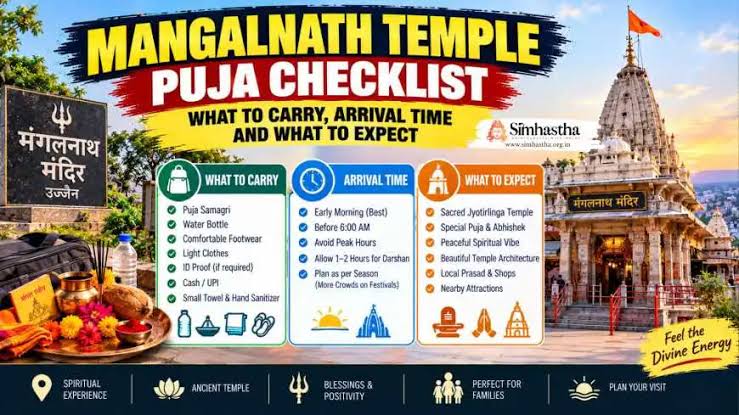
Mangalnath Temple in Ujjain is closely associated with Mangal, or Mars, in Hindu tradition. Devotees come here for regular Shiva darshan as well as Mangal Dosh Puja, Bhaat Puja and other planetary rituals. Since special pujas can take several hours, checking the temple timings before leaving can save an unnecessary wait.
Mangalnath Temple sits on Ankpat Marg beside the Kshipra River, about 6 km from Ujjain Junction. The Matsya Purana tradition identifies it as Mangal’s birthplace. The shrine is dedicated to Lord Shiva, worshipped here as Mangalnath.
If you are visiting in 2026, check the current timings, puja charges and booking details before leaving. Tuesday is sacred to Mangal and draws the heaviest weekly crowd.
About Mangalnath Temple Ujjain
Many devotees come to Mangalnath specifically for graha shanti pujas. In Jyotish, Mangal relates to courage, physical energy and land. Its difficult placements are also examined in cases involving conflict or marriage. People whose kundli is interpreted as having Mangal Dosh often visit the temple for prayer and puja.
The temple is also connected with Ujjain’s old astronomical tradition. The open location was historically considered suitable for observing Mars. Still, the main reason most devotees visit today is simple: darshan of Lord Shiva and worship connected with Mangal.
Tuesday, known as Mangalvar, has the greatest religious importance here. It is the preferred day for many Mangal-related rituals, but it also brings longer queues and more puja bookings.
Mangalnath Temple Timings 2026
The temple committee divides regular darshan into morning and evening sessions. The doors close from noon until 4:00 PM, unless the temple office has given you a different time for a booked puja.
| Temple schedule | Timing |
|---|---|
| Morning darshan | 5:00 AM to 12:00 PM |
| Midday closure | 12:00 PM to 4:00 PM |
| Evening darshan | 4:00 PM to 9:00 PM |
Schedules can shift on Tuesdays and during Shravan, Mahashivratri, Bhaumvati Amavasya and other major festivals. Simhastha crowd-control measures may change the entry route or road access as well. If Mangalnath is the main purpose of your trip, call the temple office first.
With light crowds, darshan often takes 30 to 60 minutes. On Tuesday, a wait of one or two hours is not unusual. Festivals may involve an even longer queue.
Mangalnath Temple Aarti Timings
The temple committee lists four daily aartis. The Shayan Aarti is listed at 10:30 PM, which is later than the published general darshan closing time of 9:00 PM. Visitors who specifically want to attend it should confirm whether public entry is available that night.
| Aarti | Time |
|---|---|
| Morning Aarti | 5:00 AM |
| Bhog Aarti | 11:00 AM |
| Evening Aarti | 7:00 PM |
| Shayan Aarti | 10:30 PM |
The 5:00 AM Morning Aarti is a good choice for people who want an early and relatively peaceful visit. The 7:00 PM Evening Aarti suits visitors combining Mangalnath with other Ujjain temples during the day.
Regular aarti and a booked puja are not the same. Aarti follows a fixed daily schedule. Mangal Dosh Puja, Bhaat Puja and longer anushthans are arranged separately with the temple office or an authorised priest.
Puja List at Mangalnath Temple
Mangalnath Temple is especially known for pujas related to Mars, but several Shiva and Navgraha rituals are also performed here. The religious purposes below describe traditional beliefs. A puja should be approached as a spiritual practice, not as a guaranteed solution to marriage, health or financial problems.
Mangal Dosh Puja
Mangal Dosh Puja is performed by devotees whose kundli is believed to contain Manglik or Kuja Dosh. Families often arrange it when an astrologer connects Mars with marriage delays or tension in married life.
The puja is traditionally meant to pacify a difficult Mars influence and pray for courage, stability, and harmony. Tuesday is the most popular day, so advance booking is sensible.
Bhaat Puja or Mangal Bhaat Puja
Bhaat Puja is the ritual most closely identified with Mangalnath Temple. In this puja, cooked rice is offered during the worship of Mangal. It is commonly performed for Mangal graha shanti and marriage-related concerns attributed to Mars. You can also check out this article that lists several remedies for an afflicted Mars.
Allow about one to two hours for the ritual. The exact duration depends on the vidhi, the number of participants, and whether other prayers are included.
Kaal Sarp Dosh Puja
This puja is arranged when a kundli is interpreted as having Kaal Sarp Yog or Dosh. It involves prayers connected with Rahu and Ketu and is traditionally performed for relief from repeated obstacles, instability, or fear associated with that placement.
Navgraha Shanti Puja
Navgraha Shanti includes worship of Surya, Chandra, Mangal, Budh, Guru, Shukra, Shani, Rahu, and Ketu. Devotees choose it when more than one graha is considered challenging, or before an important event such as a marriage or house ceremony.
Angarak Dosh Puja
Jyotish uses the term Angarak Dosh for certain Mars and Rahu combinations. Devotees usually choose this puja after an astrologer relates the combination to anger or impulsive behaviour. Recurring conflict and instability may form part of the reading too. The combination cannot be judged in isolation, so have the full kundli examined by a qualified practitioner first.
Rudrabhishek
Rudrabhishek is a Shiva worship ritual performed with sacred offerings and Rudra mantras. It is not limited to Mangal Dosh. Devotees arrange it for prayer, peace, wellbeing and the blessings of Lord Shiva.
Mahamrityunjay Jaap
Mahamrityunjay Jaap is a prayer for a person’s wellbeing and recovery. Some families arrange it during an illness or another difficult period, seeking protection and strength for a loved one. It is a religious observance and should never replace medical treatment.
Ark Vivah
Ark Vivah is among the services listed for people dealing with strong Manglik concerns related to marriage. The practice and eligibility can vary. Ask the temple priest what the ritual involves and whether a prior kundli assessment is needed before booking it.
Mangalnath Temple Puja Charges in 2026
The following amounts were reported in June 2026 through information attributed to the temple administration. Treat them as a recent price reference, not a permanent rate card. Confirm the full cost before the puja begins and ask for the official government receipt.
| Puja | Ritual amount | Government receipt | Reported total |
|---|---|---|---|
| General Bhaat Puja | ₹1,100 | ₹150 | ₹1,250 |
| Navgraha Puja | ₹2,100 | ₹200 | ₹2,300 |
| Kaal Sarp Dosh Puja | ₹2,100 | ₹150 | ₹2,250 |
| Panchang Karm Puja | ₹5,100 | ₹500 | ₹5,600 |
| Jap Anushthan Puja | ₹11,000 | ₹1,100 | ₹12,100 |
The quoted rate may not cover everything. A private puja, extra chants, special samagri or another ritual can raise the total. Ask what the fee covers, especially priest dakshina, havan and puja materials, and settle the price before the ceremony starts.
How to Book Puja at Mangalnath Temple
The safest starting point is the Shri Mangalnath Mandir Prabandh Samiti. The committee lists +91 96858 56131 as its phone and WhatsApp contact for puja coordination.
The booking process generally works like this:
- Choose the puja after discussing the purpose of your visit.
- Share the devotee’s name, birth details and preferred date.
- Confirm the puja timing, total charge and what the amount includes.
- Keep the booking message or WhatsApp confirmation.
- Reconfirm the slot one day before the visit.
For kundli-based pujas, keep your full name, gotra if known, date of birth, time of birth and place of birth ready. Also mention how many family members will attend. If an astrologer recommended a specific ritual, carry the written recommendation or kundli.
Advance booking is especially useful for Tuesday, Bhaumvati Amavasya, Shravan and major festivals. Walk-in puja arrangements may be available, but they depend on priest and counter availability.
Online and video-call puja
The temple has offered remote puja coordination for devotees who cannot travel to Ujjain. Video-call participation may be arranged after speaking with an authorised number. A direct payment gateway was not active when the remote service was reported in June 2026, so confirm the current payment method and request a receipt.
Avoid paying an unknown person who approaches you outside the temple. Several private booking sites and priest services use the Mangalnath name. Confirm that you are dealing with the committee office or an authorised priest before sending money.
Darshan Ticket and VIP Entry
General darshan is free, and no advance reservation is published for the regular queue. Visitors can arrive during opening hours, leave footwear at the designated counter and join the line.
The temple committee does not clearly publish a formal VIP darshan booking system. Some 2026 visitors reported a paid priority option at an onsite counter, while others found only the general queue. Since the information is inconsistent, ask at the temple office after arrival and do not depend on priority access when planning your day.
A booked puja may place devotees closer to the ritual area. This should not automatically be treated as a VIP darshan ticket.
Best Time to Visit Mangalnath Temple in 2026
The best period for a comfortable visit is October to March. Ujjain’s weather is milder during these months, making it easier to visit several temples and spend time near the Kshipra River.
Best time for peaceful darshan
Arrive between 5:00 AM and 7:00 AM on a non-Tuesday weekday. The queue is usually lighter, the weather is cooler and parking is easier to find. Wednesday through Monday is better when crowd avoidance matters more than the traditional importance of Tuesday.
Best time for Mangal-related worship
Tuesday is the main day for Mangal worship. It is the preferred choice for Bhaat Puja and Mangal Dosh Puja, but it is also the busiest day of the week. Book the ritual in advance and leave extra time for the queue.
Bhaumvati Amavasya, which is an Amavasya falling on Tuesday, draws particularly large crowds. Shravan and Mahashivratri are also busy.
Seasonal guide
- October to March: The most comfortable season for darshan and sightseeing.
- April to June: Ujjain can be very hot. Visit early and carry water and sun protection.
- July to September: Rain can make the riverfront and stone surfaces slippery. Wear suitable footwear and carry rain protection.
If you plan to visit during a festival, do not keep a tight train or flight connection after darshan. Queues and traffic diversions can change the schedule quickly.
How Much Time to Keep for the Visit
On a quiet day, darshan often takes 30 to 45 minutes. Allow one to two hours or more on Tuesday. Bhaat Puja usually lasts one to two hours, while a longer Mangal Dosh ritual or combined anushthan can run for two to three hours.
Set aside half a day if you want to perform a puja and visit nearby temples. For darshan and a little time beside the river, one to one and a half hours should be enough.
How to Reach Mangalnath Temple
Mangalnath Temple is located on Ankpat Marg, near Agar Road, Ujjain, Madhya Pradesh 456006. Auto-rickshaws, e-rickshaws and taxis are the easiest choices within the city.
From Ujjain Junction
The temple is about 6 km from Ujjain Junction. The drive generally takes 15 to 25 minutes, depending on traffic. On Tuesdays and festival days, leave extra time.
From Mahakaleshwar Temple
Mangalnath is roughly 5 km from the Mahakaleshwar area. An auto or e-rickshaw is convenient. If Mahakal is part of your itinerary, check the latest Ujjain Mahakal Garbh Grah Darshan guide before fixing the order of your visits.
From Indore Airport
Devi Ahilyabai Holkar Airport in Indore is about 53 to 55 km away. The road journey usually takes around one and a half hours, though city traffic can add time.
Nearby Places to Visit
Mangalnath can be combined with several temples in northern Ujjain. A practical half-day route is Mangalnath, Sandipani Ashram, Gadkalika Temple, Kal Bhairav Temple and Siddhavat.
- Angareshwar Mahadev: About 0.5 to 1 km away and also associated with Mars worship.
- Sandipani Ashram: Around 2 km away, traditionally linked with Shri Krishna, Balarama and Sudama.
- Siddhavat: Roughly 2 to 3 km away, known for its sacred banyan tree and ancestral rites.
- Kal Bhairav Temple: About 3 km away and one of Ujjain’s major Bhairav temples.
- Gadkalika Temple: Around 3 to 4 km away and traditionally associated with poet Kalidasa.
- Mahakaleshwar Jyotirlinga and Mahakal Lok: Around 5 km away.
- Ram Ghat: Roughly 5 to 6 km away on the Kshipra River.
Travellers planning a longer spiritual journey across Madhya Pradesh can also use this Bageshwar Dham Chhatarpur Temple guide while arranging the next part of the trip.
Food and Visitor Facilities
Tea stalls, prasad shops and puja-material vendors are available near the entrance. Simple vegetarian restaurants and dhabas can be found along Mangalnath Road and near Sandipani Ashram. Poha-jalebi works well for breakfast, while dal bafla is a filling Malwa meal later in the day.
Parking is available near the temple but fills quickly on Tuesdays. A shoe counter is available near the entrance. Visitors also report toilets, drinking water and some shaded seating, though cleanliness and availability can vary during peak periods.
Flowers, coconut, red cloth, prasad and other puja items are sold outside. If you have booked a puja, ask whether samagri is already included before buying a separate kit.
Wheelchair and senior-citizen arrangements are not clearly documented. Call the temple office before visiting, ask about the easiest entrance and choose an early non-Tuesday slot when possible.
Important Guidelines for Devotees
- Wear modest, comfortable clothes suitable for a temple visit.
- Arrive early for a booked puja and keep the confirmation ready.
- Ask for an official receipt for temple charges.
- Agree on the total puja cost before the ritual begins.
- Keep cash and UPI available, but carry few valuables.
- Leave footwear at the designated counter.
- Do not assume that a puja booking includes priority darshan.
- Avoid large bags and unnecessary luggage.
- Do not photograph the sanctum unless temple staff clearly permit it.
- Follow the queue, security and priest instructions inside the complex.
Mangalnath Temple Contact Details
| Detail | Information |
|---|---|
| Temple name | Shri Mangalnath Mandir |
| Address | Ankpat Marg, Mangalnath Mandir, Agar Road, Ujjain, Madhya Pradesh 456006 |
| Phone and WhatsApp | +91 96858 56131 |
| Distance from Ujjain Junction | About 6 km |
| Nearest airport | Devi Ahilyabai Holkar Airport, Indore, about 53 to 55 km |
Use the contact number to confirm puja slots, festival timings, remote puja availability and the latest charges. Calling before a Tuesday or festival visit can prevent a wasted trip during a schedule change. You can also visit the official website of Mangalnath Temple for more information.
FAQs About Mangalnath Temple Ujjain
Q1. What are the Mangalnath Temple timings in 2026?
The published schedule is 5:00 AM to 12:00 PM and 4:00 PM to 9:00 PM. The temple closes for a midday break.
Q2. What are the daily aarti timings?
Morning Aarti is at 5:00 AM, Bhog Aarti at 11:00 AM, Evening Aarti at 7:00 PM and Shayan Aarti at 10:30 PM. Confirm public entry for Shayan Aarti because it is later than the general darshan closing time.
Q3. Is Mangalnath Temple darshan free?
Yes. General darshan is widely reported as free, and no advance booking is published for the regular queue.
Q4. Which puja is famous at Mangalnath Temple?
Bhaat Puja and Mangal Dosh Puja are the best-known rituals. Navgraha Shanti, Kaal Sarp Dosh Puja, Angarak Dosh Puja and Rudrabhishek are also performed.
Q5. How much does Bhaat Puja cost in 2026?
A June 2026 rate reference listed ₹1,100 for the ritual and ₹150 for the government receipt, making a reported total of ₹1,250. Reconfirm the rate before booking.
Q6. Is advance booking needed for Bhaat Puja?
Advance booking is strongly recommended for Tuesdays, Bhaumvati Amavasya, Shravan and festivals. Walk-in arrangements depend on priest availability.
Q7. Can Mangalnath puja be performed online?
Remote participation through video calling has been offered. Contact the temple committee to confirm current availability, payment instructions and the puja schedule.
Q8. Is VIP darshan available?
The temple committee does not clearly publish a formal VIP scheme. Some visitors have reported paid priority entry at an onsite counter, but it is not consistently documented.
Q9. Which day is best for Mangal Dosh Puja?
Tuesday has the greatest traditional importance for Mangal worship. It is also the busiest day, so book early and allow extra time.
Q10. What is the best time for a peaceful visit?
Visit between 5:00 AM and 7:00 AM on a non-Tuesday weekday. October to March offers the most comfortable weather.
Q11. How far is Mangalnath Temple from Mahakaleshwar?
It is roughly 5 km away, depending on the route and the starting gate.
Q12. Is photography allowed?
Rules can vary by area. Do not take photos inside the sanctum unless temple staff explicitly allow it.
Final Thoughts on Mangalnath Temple Visit 2026
Mangalnath Temple is easy to include in an Ujjain itinerary, but a puja visit needs more planning than ordinary darshan. Check the opening hours, confirm the ritual slot and ask for the complete price before you arrive. This matters most on Tuesdays and festival days.
For a quiet darshan, reach the temple soon after 5:00 AM on a weekday other than Tuesday. For Mangal-related worship, Tuesday remains the traditional choice, even though the queues are longer. Keep enough time in your schedule, follow the temple’s instructions and approach the puja with clear expectations.
After darshan, visitors can spend a little time beside the Kshipra River before leaving. Whether the purpose is Shiva darshan or a specific graha shanti ritual, confirmed timings and an unhurried schedule are usually enough for a well-managed visit.